
- Older buildings were built to breathe: moisture is meant to escape through the mortar joints.
- Lime mortar is softer and more vapour-permeable than cement.
- Hard cement repointing traps moisture and can crack or erode the original brick and stone.
- Matching materials keeps the building sound and protects its heritage value.
Old buildings were built to breathe
Older buildings were built to breathe. Their walls take up moisture and let it go again, and the mortar joints are the path it is meant to take. Lime mortar is softer and more vapour-permeable than cement, so moisture escapes through the joints instead of the masonry.
What cement does to old masonry
Repointing with hard cement mortar traps moisture and can crack or erode the original bricks and stone. Because the cement joint is harder and less permeable than the brick or sandstone around it, water and the salts it carries are pushed into the masonry itself. Over time the face of the brick or stone breaks down while the cement joint survives. The joint should be the part that wears, because it is far easier to repoint than to replace a heritage brick or block of sandstone.
Matching materials
Good heritage work matches what is already there: lime mortars for walls and ceilings, matched brick where a wall has to be rebuilt, and finishes such as tuckpointing and white-set plaster where the building calls for them. Matching materials keeps the building sound and protects its heritage value.
An example from Millers Point
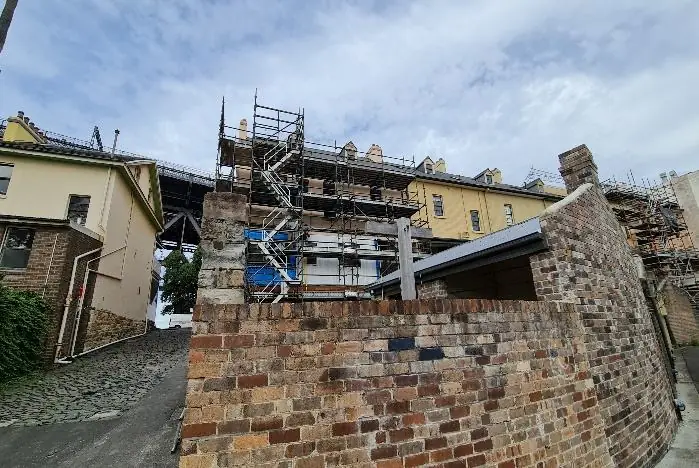
Across six heritage projects in Millers Point we cleaned and repointed sandstone, restored lime mortar walls and ceilings, rebuilt a heritage wall in matching brick with a tuckpointed finish, and injected damp proofing into sandstone walls, alongside roof, joist and lintel replacement.
The conservation approach
We follow the Burra Charter, the Australia ICOMOS charter for places of cultural significance. If your home is heritage listed or in a heritage conservation area, check the approvals needed with your council before work starts; we confirm them with your heritage adviser and certifier.
See our heritage restoration services or get in touch about your project.